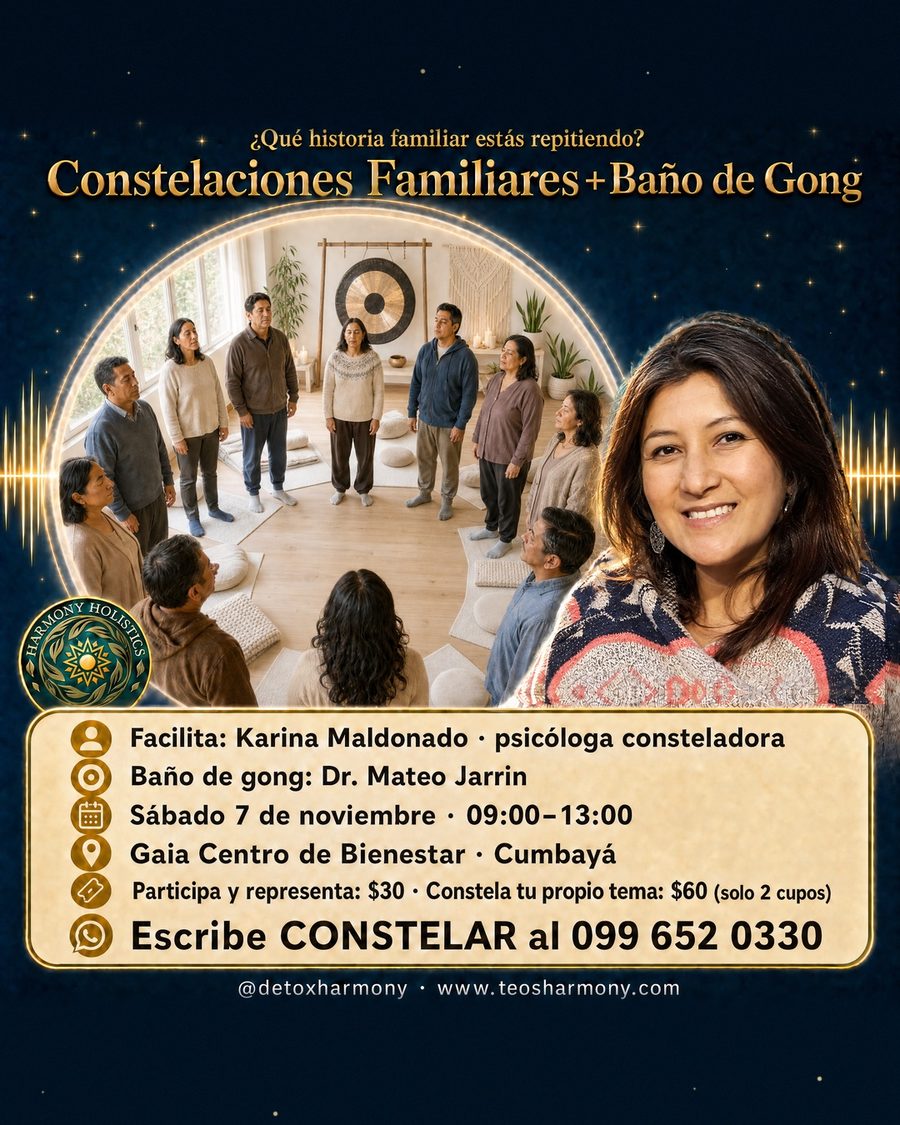
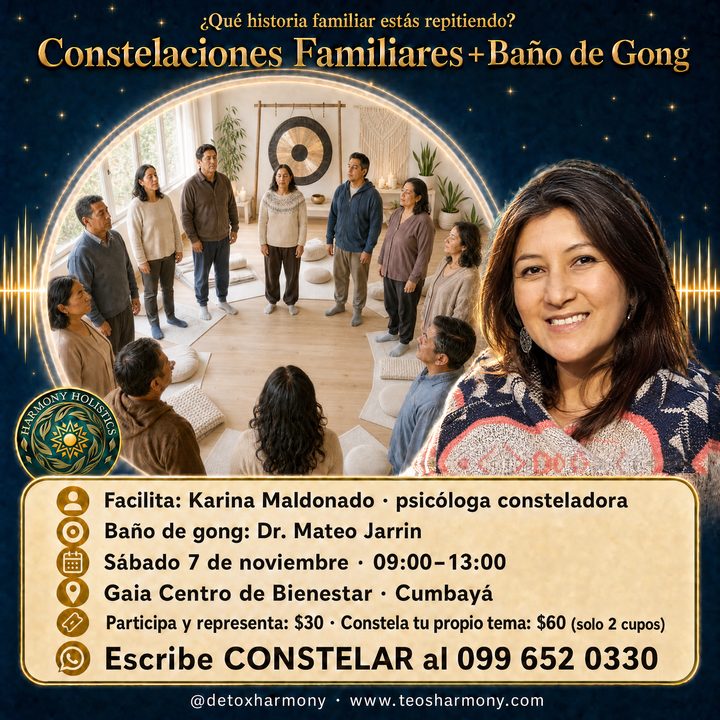
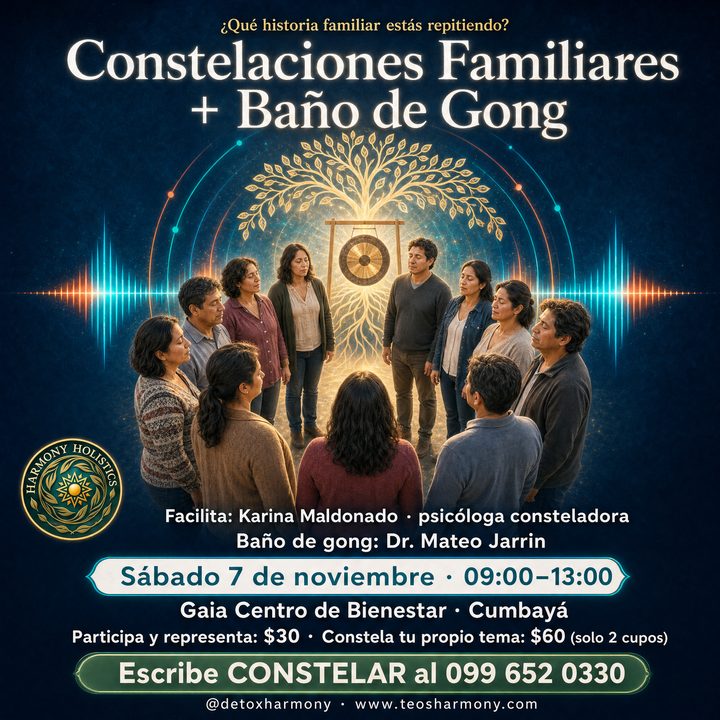
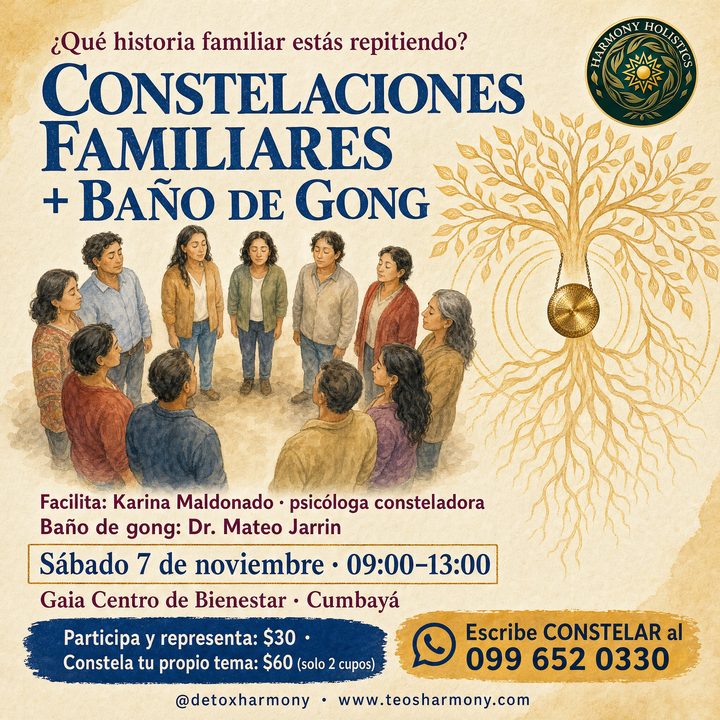
Facilitated by: Karina Maldonado, Dr. Mateo Jarrin
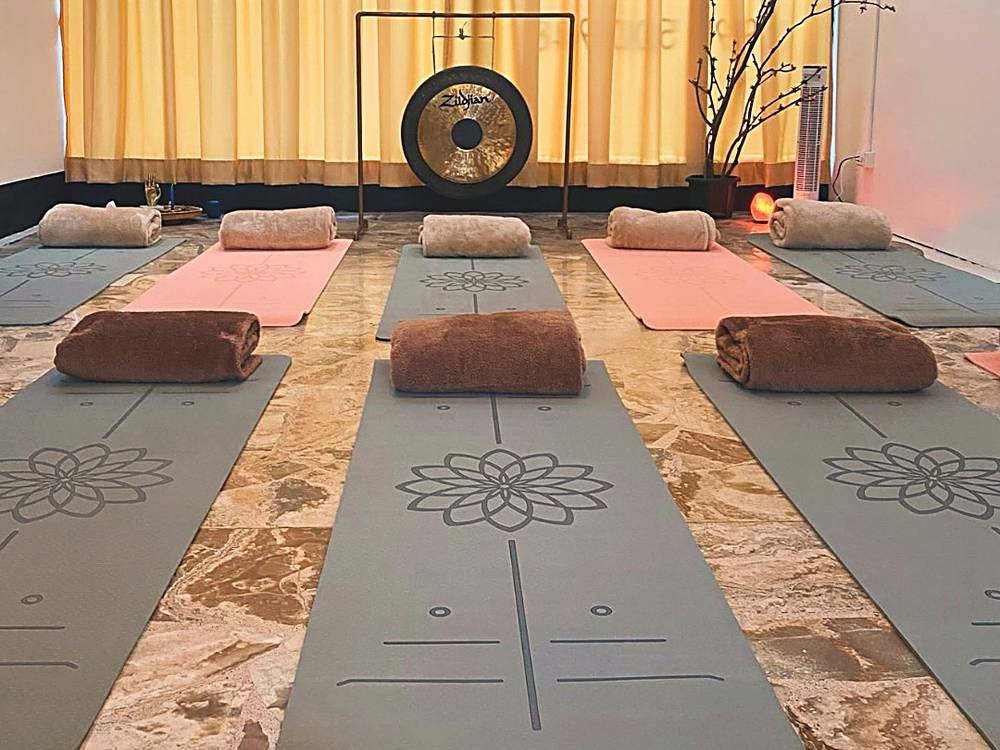
A morning that brings Family Constellations and a gong bath together: first we look at the family dynamics that repeat, then the sound of the gong helps the body settle what moved.
Choose the date, choose how you want to come, and we confirm by email. It takes about a minute.
What Family Constellations are
We inherit more than a surname from our family. We also inherit ways of loving, of suffering, and of staying silent. A constellation lets you see that map clearly: who belongs, who was left out, and what you have been carrying on someone else's behalf.
It is an experiential method, not a medical treatment. It does not replace medical or psychiatric care. Controlled research on constellations is still limited, so we say what people report rather than what is proven.
Where the method comes from
Bert Hellinger developed Family Constellations in the second half of the twentieth century, drawing on systemic family therapy, group dynamics and his own work with families. Karina works from his framework.
Three ideas the method rests on
01
Belonging
Everyone who belongs to a family has an equal right to be part of it, including the ones nobody talks about. When someone is left out, a later member often carries them without knowing it.
02
Order
There is a natural sequence: parents come before children, and what happened earlier comes before what happened later. When that order is reversed, something is strained.
03
Balance
Giving and receiving move back and forth between people. When the exchange is badly out of balance, a relationship carries a debt that no one named.
Invisible loyalties
The central idea is the invisible loyalty: a hidden, often loving attachment to someone in the family line, which shows up as a pattern you cannot talk yourself out of. You did not choose it. You inherited it.
Before you come
How a constellation works, start to finish
For anyone who has never been, has never thought about it, or thinks the whole thing sounds made up. Here is the whole shape of it, so you know what you are walking into.
Four ways to come
Come and watch
You can sit in the circle and do nothing else. There are around twenty to twenty-five places for exactly that. Watching is a real way to attend, and it is often all someone needs.
Participate and represent
You may be asked to stand in for a member of someone else's family. It is always voluntary, and people often say it taught them the most.
Constellate your own theme
You bring one situation and the session is built around it. Places for this are limited, because each one takes real time.
Bring a question, or just ask for help
If you are not sure, come and ask. You can talk it through first and decide later, including deciding not to constellate at all.
What happens, in order
1
The theme is named
one sentence, not your life story
2
The family is set up
who is placed where, and who is missing
3
The representatives report
what they feel, and who they cannot face
4
The movement
where each one wants to move, and what gets tried
5
The close
whether the picture has settled, and what is left standing
What the facilitator is reading
Who cannot look at whom
A representative who turns away, or stares at the floor, is often the clearest information in the room.
Who is missing
When a place in the family is empty, someone tends to keep looking for it. Filling it is often the whole movement.
Who steps back
A wish to retreat usually marks the person carrying something that was never theirs to carry.
What the body shows
Heaviness, cold, tears with no story attached. Physical signals are read exactly like words.
You do not have to believe any of this to come. Nobody will ask you to accept the field, or anything else. A participant place is $30, and watching the whole process from that place is a complete way to attend.
What actually happens in a session
Not knowing what will happen is the main reason people hesitate. So here is the whole thing in plain language, before you decide anything.
1
You name one thing, in one sentence
You speak for about a minute.
Not your life story. One situation: a relationship that keeps failing, money that never stays, a grief that will not move. Something like: I keep choosing partners who leave. The facilitator asks for a few facts and nothing more: who is in your family, who died young, who left, who is never mentioned. Facts, not opinions. You decide how much to say, and you can stop there.
2
The facilitator chooses the representatives and places them
You watch. You arrange nothing.
She picks people from the group to stand in for your mother, your father, a sibling, someone who died, someone nobody talks about. She decides who stands for whom, and she places each one herself, by feel rather than by reasoning: close or far, facing each other or turned away. You are not directing it and you do not have to work anything out. Those positions are what the rest of the session reads. Only two people constellate in a workshop, which is why two people bring a question. Everyone else, around twenty to twenty-five of you, sits in the circle and watches the whole process.
3
The representatives say what they feel
You listen. Nobody asks you anything.
This is the part nobody expects, and it is the reason people come back. The representatives know nothing about your family, and one by one they report what they notice in the position they were given: heaviness in the chest, an urge to step back, a wish to look at the floor, or not being able to look at one particular person. Nobody is acting and nobody is told what to feel. A picture forms in the room that matches something in your family, often something you have never seen clearly.
4
The movement, the sentences, and the close
You may say a few short sentences out loud.
The facilitator tests small movements. Someone who was left out is brought in. Someone is turned to face another. Short sentences are spoken out loud, and they are the part people remember: You belong. I see you. I give you your place. I take my life, and you take yours. You are big, and I am small. Often you bow. Nobody asks you to analyse it or explain what it meant. The picture settles and it is left like that. Afterwards you are told to let it work quietly, which is why people usually notice the change in the weeks that follow rather than in the room.
What is asked of you
You do not have to tell your story. Many people name a theme and nothing more.
You do not have to speak in front of the group unless you choose to.
You may be asked to stand in for someone else. It is always voluntary, and it is often where people learn the most.
Everything in the room is confidential. What happens in the circle stays in the circle.
A workshop runs about four hours. Most people are tired afterwards, and that is normal.
Afterwards
One session shows a picture. What you do with it is the work. People usually notice the change in the weeks that follow rather than in the room, and some themes are worth returning to later.
What a representative is
A representative is a stranger from the group who stands in for a member of your family. They are not acting and they are not told your history. They simply report what they feel in that position. People are often surprised by how much a stranger registers in a place they know nothing about.
The field
What is the morphic field?
The short version: a family keeps its memory somewhere other than in any one person's head.
Biologist Rupert Sheldrake proposed the name morphic field for this. His idea is that living systems are connected by a field that carries information, memory and form, and that this memory passes on without being stored in any single member. In constellation work the same word describes something plainer: the emotional memory a family carries. The grief nobody finished. The name nobody says out loud. The person who was written out of the story. It is not filed in a drawer anywhere. It is still active.
How to recognise it in yourself
You repeat stories from your parents or grandparents without noticing.
You feel intense emotions with no apparent cause, a deep sadness or a guilt that does not fit.
One area of your life will not move, relationships, money or health, and you cannot say why.
You carry responsibilities that were never yours.
There are secrets, exclusions or unfinished grief in your family history.
Why representatives seem to know things
In a constellation the representatives are told nothing about your family. They then report feelings that fit. That is the observation the field idea is trying to explain. We are not claiming to know the mechanism. We are saying the phenomenon is consistent enough to work with, and that it is neither magic nor proof of anything.
Can what is in the field change?
A constellation does not erase what happened. It gives it a place. When someone who was excluded is named, when a grief that was kept quiet is honoured, the pattern stops needing to be carried by whoever comes next.
Nothing is truly lost in a family. What is not said, what is not honoured, what is excluded, shows up later.
Bert Hellinger
What people bring
These themes come up most often. Each case below is a composite: an illustrative case, not a real client, shown with their permission as an example of the pattern.
01
Mariana
Repeating relationships
Illustrative case
Three relationships in eight years, each with a man who was emotionally or physically absent. Her father left when she was six, and her mother often said that men always leave. In the constellation, Mariana's representative could not look at the father at all. She kept watching the door.
Sometimes we stay loyal to a parent by not having what they did not have.
02
Carlos
Money that never stays
Illustrative case
A capable contractor who earns well and is broke every December. His grandfather lost the family land in a bad deal and died ashamed, and the family carried it as a debt. When Carlos turned to face his grandfather and acknowledged the loss, the money representative stopped circling.
Failing can be a hidden way of staying close to someone who failed.
03
Diego
Cannot let anyone in
Illustrative case
Successful and cold. His mother left for Spain when he was five and sent money for twelve years. In the constellation the child representative turned away from her, while the mother's representative kept reaching toward him.
A child who waited too long can decide never to wait for anyone again.
04
Lucía
Caring for a parent
Illustrative case
Every visit to her mother ends in a fight, and Lucía feels responsible for her mother's sadness. Her mother had lost a baby before Lucía was born, and no one in the family ever spoke about it.
When someone is left out of the family story, another member often carries them.
05
Andrés
A marriage of three
Illustrative case
Married four years, fighting weekly about his mother, who called daily. In the constellation his wife felt she was looking at his back, while his mother stood where a partner should stand.
A new family comes first. Honouring your parents and leaving their side are not the same thing.
How you can work with this
One session shows a picture. What you do with it afterwards is the work.
Group workshop
Half a day in Quito, with two constellations and around twenty to twenty-five places to watch. Come to sit in the circle, or to bring a question of your own.
$30
to participate
$60
to constellate
Private session
The same method with small figures on a table instead of people, in Quito or online. Best if you would rather not do group work.
$45
per session
Online session
Figures on camera or a shared board. Works for clients outside Quito and abroad.
$45
per session
At our retreats
Karina leads the constellation and integration circles at every Harmony Retreats programme.
Who facilitates
Licensed Psychologist · Master in Family Constellations
Karina Maldonado is a licensed psychologist with a Master's in Family Constellations, working from a transpersonal psychology foundation. She works in Quito and online, in Spanish and English, and leads the constellation circles at Harmony Retreats. A licensed psychologist with formal training in the method is not the norm in this field, and it is the reason we lead with it.
No. Most people come with a pattern that keeps repeating: in relationships, with money, with a parent, or with grief that does not move. You do not need a diagnosis, and you do not need to be in crisis.
Do I have to talk in front of everyone?
No. With a participant place you do not have to share anything personal. You take part, you observe, and if you feel comfortable you can represent in someone else's constellation.
Do I have to bring my family?
No. Your family does not need to attend, be present, or even know you are there. Representatives stand in for them.
What if I do not know my father, or I know little about my family?
That is common, and it is workable. The constellation works with what you know. Missing information is often part of what shows up.
What is the difference between participating and constellating?
A participant place, $30, takes part in the group: you accompany the constellations, you may be asked to represent, and you join the whole session. A constellator place, $60, works on your own theme: you choose the situation and the constellation is set up for you. Only two people constellate in a workshop, so there are two constellator places and they go in order of payment.
I have never been to anything like this. Is that a problem?
Not at all. Most people are there for the first time. With a participant place you do not have to tell your story, and everything that happens in the group is confidential.
Does one session fix it?
One session shows a picture. What you do with it afterwards is the work. People usually notice changes over the following weeks rather than in the room, and some themes are worth returning to later.
Can I do it online?
Yes. Private sessions run online with figures on camera or a shared board, and they work well for clients outside Quito.
Is this a religion, or against my religion?
It is neither. Family Constellations is a therapeutic and experiential method, not a belief system or a religious practice. You are not asked to adopt anything.
Does it replace therapy or medical care?
No. It is an experiential method and it does not replace medical or psychiatric treatment. We ask that anyone in acute crisis or under psychiatric care speak with Karina before joining a group.
Is it confidential?
Yes. What happens in the circle stays there. That is part of what makes the room work.
What should I bring?
Comfortable clothing and a bottle of water. Mats, blankets and cushions are provided at the centre, so you do not need to bring your own. Please arrive ten minutes early, because the session starts on time.
Do I have to believe in the field?
No. Nobody will ask you to accept any explanation of how this works. What matters is what you notice in the room and afterwards. We call it a field because that is the closest word we have, and you are free to call it something else.
The people and the room
Real photographs from the work, not stock. We add new ones after each workshop.
Karina Maldonado facilitates the constellationsThe November workshop: constellations and a gong bathHalf a day, in person in CumbayáGroup work she holds in Quito and onlineThe room is a circle, and everyone is in it
The room
Where it happens
Gaia Centro de Bienestar, Cumbayá. This is the room the workshops are held in.
Gaia Centro de Bienestar, CumbayáGaia Centro de Bienestar, Cumbayá
Watch
See what a constellation is, in two minutes.
Two short videos we made for the workshop. Turn sound on.
¿Qué es una Constelación Familiar?0:43Las medias0:43
Message CONSTELAR
Send the word CONSTELAR on WhatsApp. We will send you the free guide, the next dates, and one question: what situation in your life would you like to look at? That tells us whether the workshop or a private session fits you better.