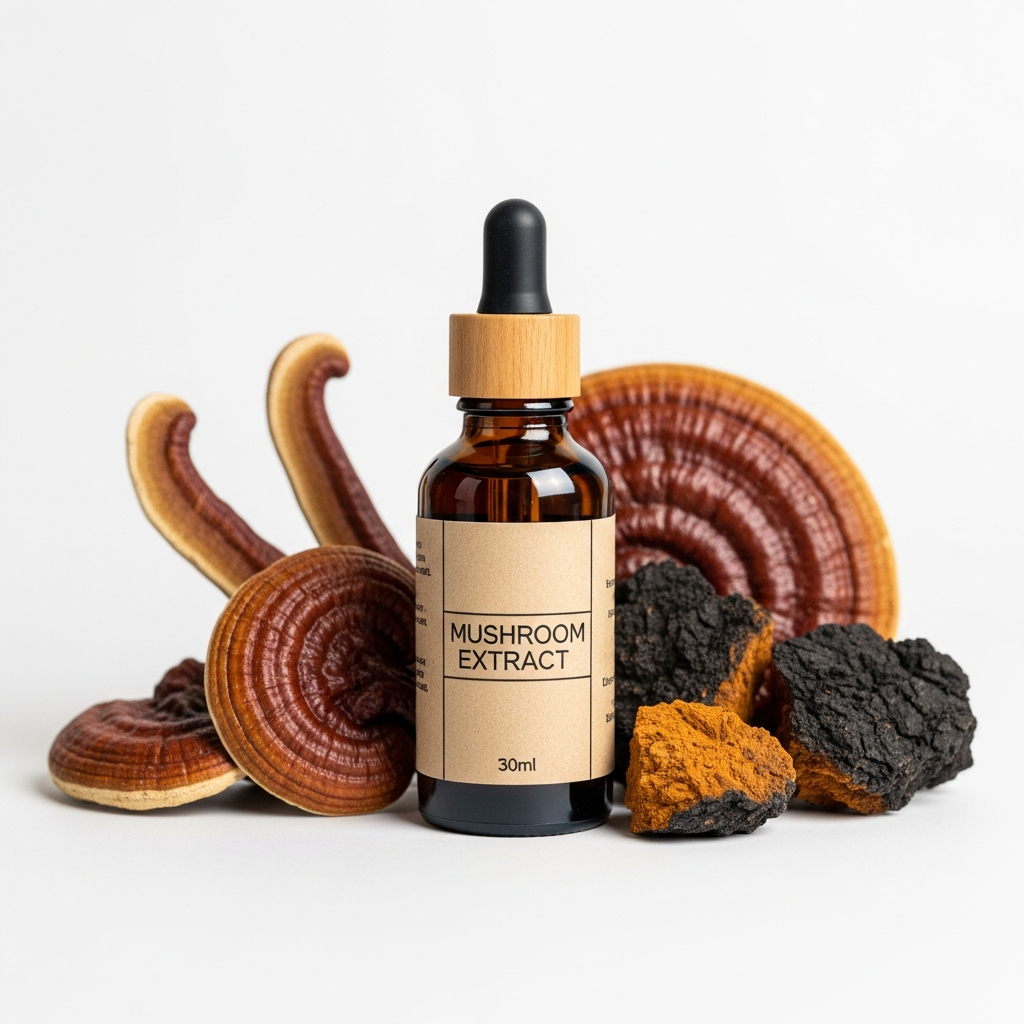
Mushroom Extracts: Traditional Uses and Modern Interest
Discover the fascinating world of medicinal mushrooms, from ancient traditional use to modern scientific exploration.
A Long History of Use
Medicinal mushrooms have been used in traditional wellness practices for thousands of years, particularly in Asian and indigenous cultures. Today, modern research is exploring the compounds that make these fungi so interesting.
Key Mushroom Extracts
Chaga (Inonotus obliquus)
Growing primarily on birch trees, chaga has been used in Russian and Scandinavian folk traditions. It contains melanin, betulinic acid, and various polysaccharides.
Lion's Mane (Hericium erinaceus)
This distinctive mushroom has garnered scientific interest for its hericenones and erinacines — compounds that researchers are studying in relation to nerve growth factor.
Turkey Tail (Trametes versicolor)
One of the most extensively studied medicinal mushrooms, turkey tail contains polysaccharide-K (PSK), which has been the subject of numerous research studies.
Reishi (Ganoderma lucidum)
Known as the "mushroom of immortality" in traditional Chinese wellness practices, reishi contains triterpenes and polysaccharides.
Cordyceps (Cordyceps militaris)
Traditionally used in Tibetan and Chinese wellness practices, cordyceps has been studied for its cordycepin content.
Quality Matters
When selecting mushroom extracts:
This content is for informational purposes only and is not intended to diagnose, treat, cure, or prevent any disease.
Continue Exploring
Hand-picked next steps related to this article.
Browse the full apothecary
144 herbs sortable by goal, system, or origin.
Find the right assessment
Match herbs to your nervous-system or body-system needs.
Curated wellness stacks
Pre-built educational frameworks by goal.
The science behind the apothecary
Researchers and traditional teachers grounding our work.
Ready to start your personalized wellness journey?
Take our research-backed assessments and receive personalized educational reports.